
Spec Continuous Insulation Wall Systems for R-Value
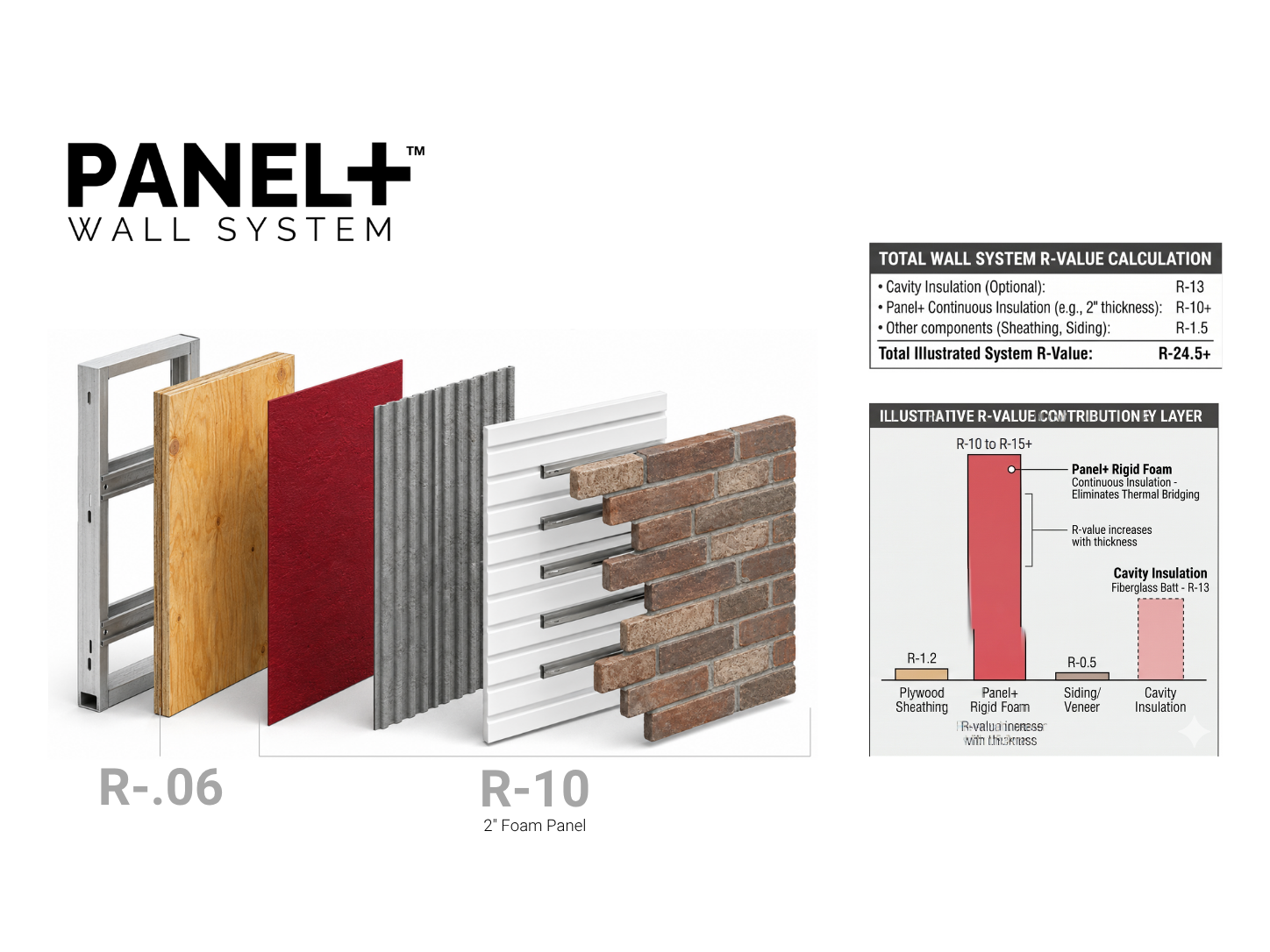
Meeting today's stringent energy codes demands more than just stuffing insulation between studs. As building performance requirements tighten, architects and building designers need wall systems that eliminate thermal bridging while managing moisture and maintaining constructible details. Old Mill Building Products gives you an integrated approach to specifying high-performance CI wall systems that hit target R-values without sacrificing design flexibility or installation efficiency.
This guide walks you through everything from fundamental building science principles to advanced detailing strategies. You'll learn how to select the right insulation materials, calculate effective R-values, manage moisture at critical junctions, and create specifications that contractors can actually build. Along the way, we'll share practical dos and don'ts that prevent the most common CI failures.
Key Takeaways: Spec Continuous Insulation Wall Systems for R-Value
- CI eliminates thermal bridging at framing members, which can account for up to 30% of heat loss in insulated buildings.
- Target R-values depend on climate zone, with IECC 2024 now requiring CI on steel-framed walls in Climate Zone 4 and above.
- Old Mill Building Products Panel+ delivers an R-value of 4.2 per inch with integrated air and water barriers for code-compliant assemblies.
- Proper detailing at window openings, corners, and penetrations prevents the moisture failures that plague poorly specified CI assemblies.
- Selecting materials with appropriate vapor permeability ensures your wall assembly can dry in at least one direction and avoid moisture accumulation.
What Is a CI Wall System and Why Does It Matter for R-Value?
A CI wall system places insulation on the exterior of the structural sheathing, wrapping the building in an unbroken thermal layer. Unlike cavity insulation installed between studs, CI creates a thermal break that stops heat from escaping through wood or steel framing members.
This distinction matters because framing acts as a thermal bridge. Wood studs have an R-value of only about R-1.25 per inch, while steel studs conduct heat even more readily. In a typical 16-inch on-center wall, roughly 25% of the wall area consists of solid framing—a significant pathway for heat loss.
By positioning insulation outside the sheathing, CI keeps the structural components warm and dramatically improves the wall's effective R-value. The result is a building that performs closer to its rated specifications while reducing condensation risk at the sheathing layer.
How Thermal Bridging Affects Your Wall's Actual R-Value
When you specify R-19 cavity insulation, you might expect R-19 performance across the entire wall. Reality tells a different story. Heat flows through the path of least resistance, and framing members offer that path.
Research shows thermal bridging can account for heat loss of up to 30% in otherwise well-insulated buildings. This gap between rated and actual performance frustrates energy modeling predictions and can cause buildings to miss code compliance targets during testing.
CI addresses this problem by creating an exterior "sweater" around the building. With insulation covering studs, plates, and headers, heat must pass through the full thermal layer before reaching the exterior environment. Your specified R-value becomes your actual R-value.
Understanding R-Value Requirements by Climate Zone
The International Energy Conservation Code (IECC) establishes minimum R-value requirements based on climate zone. These requirements have tightened significantly in recent code cycles, with the 2024 IECC making CI mandatory for steel-framed and metal building walls in Climate Zone 4 and above.
Climate Zones 1-3: Hot and Mixed Climates
In warmer regions, wall insulation requirements focus on managing solar heat gain and cooling loads. Prescriptive paths typically allow cavity-only insulation, though CI can still improve performance and simplify code compliance.
For these zones, you'll often see R-13 to R-20 cavity requirements with optional CI values of R-5 to R-7.5. Adding even modest exterior insulation helps manage the temperature differential during extreme heat events.
Climate Zones 4-5: Mixed and Cool Climates
These transitional zones face both heating and cooling demands. The 2024 IECC requires R-13 cavity plus R-7.5 CI, or R-20 cavity plus R-3.8 CI for wood-framed walls. Steel framing faces stricter requirements due to higher conductivity.
Most projects in these zones benefit from 1.5 to 2 inches of exterior foam insulation. This thickness keeps the sheathing warm enough to prevent winter condensation while remaining buildable with standard fasteners and furring methods.
Climate Zones 6-8: Cold to Subarctic Climates
Cold-climate construction demands the highest R-values. Prescriptive paths require R-20 cavity plus R-10 CI or higher, with some jurisdictions pushing toward R-15 exterior insulation requirements.
In these climates, managing the ratio between cavity and exterior insulation becomes critical. Too much cavity insulation relative to CI can allow the sheathing to drop below dew point temperatures, leading to moisture problems.
How to Calculate Effective Whole-Wall R-Value for CI Assemblies
Calculating whole-wall R-value requires accounting for every layer in your assembly, from interior drywall through exterior insulation. Start by listing each component and its R-value per inch, then multiply by actual thickness.
Step 1: Identify Assembly Components
A typical CI wall includes interior gypsum board (R-0.45), stud cavity insulation (R-3.5 to R-6 per inch depending on type), structural sheathing (R-0.5 to R-1.25), exterior CI (R-4 to R-6 per inch), and air films (R-0.68 interior, R-0.17 exterior).
Don't forget the cladding attachment system. Furring strips, rainscreen battens, and even long screws create minor thermal bridges that affect total performance.
Step 2: Calculate the Clear-Field R-Value
Add the R-values of all layers at a section that doesn't pass through framing. This gives you the maximum theoretical performance of your assembly. For example, a 2x6 wall with dense-pack cellulose (R-21), 2 inches of polyiso CI (R-12), and standard components might yield R-35 in the clear field.
Step 3: Apply Framing Factor Adjustments
Use parallel path calculation methods to account for thermal bridging through framing. Most energy codes accept a 25% framing factor for standard construction. Software tools like ASHRAE's COMcheck or building energy modeling programs automate these calculations.
What Materials Should You Specify for CI Wall Systems?
Material selection affects R-value, moisture management, fire performance, and installation complexity. Each option brings distinct advantages depending on project requirements.
Expanded Polystyrene (EPS) Foam
EPS offers R-4 to R-4.6 per inch depending on density. It's vapor-permeable (up to 5 perms per inch for Type I), allowing drying to the exterior. EPS costs less than other foam options but may require multiple layers with staggered seams due to potential shrinkage over time.
For fire code compliance, EPS requires a thermal barrier on the interior and may need additional protection in certain assemblies. Check local requirements for NFPA 285 compliance before specifying.
Extruded Polystyrene (XPS) Foam
XPS delivers R-5 per inch with higher compressive strength than EPS. Its lower vapor permeability (approximately 1 perm per inch) makes it a Class II vapor retarder at typical thicknesses, which influences where you locate your primary moisture barrier.
Consider the environmental impact when specifying XPS. Traditional blowing agents have high global warming potential, though some manufacturers now offer lower-GWP alternatives.
Polyisocyanurate (Polyiso) Foam
Polyiso offers the highest R-value per inch, ranging from R-5.6 to R-6.5 depending on temperature and facing type. Foil-faced polyiso acts as a Class I vapor retarder, essentially stopping vapor diffusion through the exterior insulation layer.
In cold climates, polyiso R-value decreases at lower temperatures—a phenomenon called thermal drift. Account for this when calculating winter heating performance in Climate Zones 6 and higher.
Mineral Wool (Stone Wool) Boards
Mineral wool offers approximately R-4.2 per inch with several performance advantages. It's non-combustible, making it attractive for fire-resistive assemblies and wildland-urban interface construction. It's also highly vapor-permeable and hydrophobic—water drains through it rather than being absorbed.
The trade-off comes in installation. Mineral wool requires gloves and respiratory protection during handling, and its lower compressive strength demands careful fastener selection to prevent crushing.
Wood Fiber Boards
Wood fiber insulation boards offer approximately R-3.5 per inch with excellent environmental credentials. They're vapor-permeable, have high compressive strength, and often feature tongue-and-groove edges that simplify installation and eliminate gaps between panels.
Long popular in Europe, wood fiber boards are gaining availability in North American markets. Their hygroscopic nature means they can buffer moisture without losing thermal performance.
How Old Mill Building Products Panel+ Simplifies CI Specifications
Specifying CI typically means coordinating separate products for insulation, air barriers, water-resistive barriers, and cladding attachment. Old Mill Building Products Panel+ integrates these functions into a single wall system.
Panel+ combines EPS foam insulation with built-in air and water barriers, plus integrated drainage channels and a precision alignment system for thin brick, stone, or tile finishes. Each inch of Panel+ adds an R-value of 5, with thickness options from 1 inch to 4 inches allowing you to achieve up to R-20 from the insulation layer alone.
The system is fully NFPA 285 compliant, addressing fire safety requirements for multi-story buildings. Its patented design includes cross-drainage channels that manage incidental moisture while allowing the drainage plane to dry effectively. You can explore the Panel+ wall system specifications for complete technical details.
What Role Does Vapor Permeability Play in CI Wall Assembly Design?
Vapor permeability determines how water vapor moves through your wall assembly. Getting this wrong leads to moisture accumulation, mold growth, and eventually structural damage. Getting it right creates a durable wall that can dry when it gets wet.
Understanding Perm Ratings and Vapor Classes
Vapor permeability is measured in perms. Materials under 0.1 perms qualify as Class I vapor retarders (vapor barriers). Those between 0.1 and 1.0 perms are Class II vapor retarders, while 1.0 to 10 perms indicates a Class III vapor retarder. Anything above 10 perms is considered vapor-open.
As insulation thickness increases, permeability decreases proportionally. Two inches of XPS at 0.5 perms per inch becomes 0.25 perms total—a Class II vapor retarder that significantly affects drying potential.
The Warm-Side Vapor Control Principle
A reliable rule of thumb positions your lowest-perm material on the warm side of the assembly. In heating-dominated climates, this means the exterior insulation should be more permeable than interior layers, allowing the wall to dry outward.
In cooling-dominated climates where vapor drive pushes inward, you might want lower permeability on the exterior to slow moisture entry. The key is avoiding assemblies that trap moisture between two low-perm layers.
Climate-Specific Strategies
Mixed climates face vapor drive in both directions at different times of year. Here, vapor-open CI materials like mineral wool or wood fiber board allow drying in whichever direction conditions favor. Alternatively, use enough exterior insulation to keep the sheathing warm year-round.
How to Manage Water at CI Wall System Details
Water intrusion at poorly detailed penetrations and transitions causes more CI failures than material defects. Your specification must address every junction where water might enter the assembly.
Window and Door Openings
Window installation in CI walls presents unique challenges. The window flange must connect to the water-resistive barrier, but that barrier might be located at the sheathing or at the exterior face of the insulation, depending on your assembly design.
For outie windows (installed at the CI face), products like ThermalBuck create a mounting point flush with the insulation while maintaining thermal break performance. The buck allows flanged windows to install using familiar methods while carrying flashing connections back to the WRB.
Innie windows (set at the sheathing plane) require site-built plywood bucks that extend through the insulation depth. This approach works well with self-adhered WRBs applied to sheathing and mineral wool or vapor-open CI materials.
Base of Wall and Foundation Transitions
The base of wall is where bulk water management meets CI installation. Install a kickout flashing at the bottom of the insulation layer to protect exposed edges and direct any incidental water away from the assembly.
Extend your air barrier from the sheathing to the foundation or slab edge to maintain pressure boundary integrity. Use compatible tapes or sealants rated for below-grade conditions where the air barrier contacts concrete.
Penetrations and Mechanical Equipment
Every pipe, duct, electrical box, and hose bib creates a potential water entry point. Detail penetrations with appropriate flashing collars that integrate with both the WRB and the CI layer. Pre-manufactured solutions exist for common penetration types and sizes.
What Detailing Mistakes Should You Avoid with CI Wall Systems?
Learning from common failures helps you write specifications that produce durable buildings. These mistakes appear repeatedly in CI assemblies that develop problems.
Insufficient Insulation Ratio
Adding too much cavity insulation relative to exterior CI can create condensation problems. The ratio matters because cavity insulation keeps heat from reaching the sheathing, while CI keeps the sheathing warm. If your cavity insulation is too effective relative to your CI, the sheathing temperature drops into the danger zone.
Use IRC Table R702.7(3) or equivalent commercial code tables to verify your assembly ratio meets minimum requirements for your climate zone.
Gaps at Insulation Joints
Butt joints between CI panels create thermal bridges and potential moisture paths. Specify tongue-and-groove panels where available, or require multiple layers with staggered seams. For foam products prone to shrinkage, staggered seams are essential.
Include inspection hold points in your specification requiring visual verification of joint coverage before cladding installation proceeds.
Incompatible Material Combinations
Some CI materials react poorly with certain adhesives, sealants, or flashing materials. EPS dissolves when contacted by petroleum-based solvents. Some acrylic tapes don't adhere well to foil-faced polyiso without primers.
Require mock-up assemblies and compatibility testing before full installation begins. Reference manufacturer technical bulletins for approved accessory products.
Crushing CI Under Fasteners
Low-density EPS and mineral wool can crush under aggressive structural screws, creating uneven surfaces for cladding attachment. Specify CI materials with compressive strength appropriate for your fastening method, or require adjustable fasteners that prevent over-driving.
How to Attach Cladding Over CI Wall Systems
Cladding attachment through thick CI requires longer fasteners and often benefits from a rainscreen approach. Your specification should address both structural and moisture management considerations.
Furring Strip and Batten Systems
Vertical furring strips or horizontal battens fastened through CI into framing create a secure nailing base for siding while establishing a rainscreen gap. This air space promotes drainage and drying behind the cladding.
Calculate fastener length to achieve at least 1.5 inches of penetration into framing after passing through battens, CI, and sheathing. For 2 inches of CI with 0.5-inch sheathing and 0.5-inch battens, you'll need minimum 4.5-inch screws.
Structural Screw Requirements
Standard siding nails won't handle thick CI assemblies. Specify structural screws designed for exterior insulation applications. Products from manufacturers like FastenMaster and GRK are engineered for these loads and include corrosion-resistant coatings.
Reference Building Science Corporation's cladding attachment reports for load tables based on CI thickness, framing type, and cladding weight. Heavy claddings like thin brick or stone veneer require more frequent fastening and may need engineering verification.
Rainscreen Gap Benefits
The space between CI and cladding serves multiple functions. It allows incidental water to drain downward, promotes air circulation that accelerates drying, and equalizes pressure across the cladding to reduce water infiltration during wind-driven rain.
Minimum gap recommendations range from 0.375 inch to 0.75 inch depending on climate and cladding type. Larger gaps improve drainage performance but require longer fasteners.
How Does Fire Code Compliance Affect CI Specifications?
Foam plastic insulation on building exteriors faces fire code requirements that vary by building type, height, and construction classification. Understanding these requirements prevents costly redesigns late in the project.
NFPA 285 Testing Requirements
For buildings over 40 feet tall with combustible CI, NFPA 285 testing demonstrates that the wall assembly limits fire spread. This intermediate-scale fire test evaluates the complete assembly, not just the insulation material.
Specify tested assemblies rather than individual components. Old Mill Building Products Panel+ is fully NFPA 285 compliant, simplifying your fire code compliance path for projects requiring this testing.
Thermal Barrier Requirements
Most foam plastics require a thermal barrier (typically 0.5-inch gypsum board) between the insulation and occupied spaces. Some assemblies allow alternative protection methods based on specific fire testing.
The thermal barrier requirement applies to interior-side exposure. Exterior protection depends on the cladding system and assembly configuration.
Non-Combustible Alternatives
Mineral wool CI meets non-combustible requirements under ASTM E136, eliminating some code restrictions that apply to foam plastics. For projects in wildfire-prone areas or with strict fire-resistive requirements, mineral wool may simplify compliance.
Creating Specifications That Contractors Can Build
The gap between architectural intent and field execution causes many CI failures. Your specification should translate performance requirements into buildable instructions.
Include Clear Performance Criteria
State required R-values, air leakage rates, and fire ratings explicitly. Reference code sections and testing standards. Avoid vague language like "high-performance" without defining measurable thresholds.
Specify Installation Sequences
CI installation involves multiple trades working in sequence. Your specification should clarify who installs what, in what order, and how work is coordinated between weather barrier, insulation, and cladding installers.
Require Submittals and Mock-Ups
Request product data sheets, installation instructions, and warranty documentation before materials arrive on site. For complex assemblies or first-time installers, require a mock-up panel demonstrating proper execution of critical details.
Define Inspection Hold Points
Specify when the designer or third-party inspector must approve work before it's covered. Key hold points include WRB installation, CI joint coverage, window flashing integration, and air barrier continuity at penetrations.
Checklist: Specifying CI Wall Systems for R-Value Compliance
Use this checklist when developing CI wall specifications to ensure all critical items are addressed:
Pre-Design Verification
- Confirm climate zone and applicable energy code version
- Verify minimum R-value requirements for wall assemblies
- Identify fire code requirements based on building height and type
- Determine project-specific performance targets beyond code minimums
Material Selection
- Select CI material appropriate for climate and performance requirements
- Verify insulation thickness achieves target R-value
- Check cavity-to-CI ratio for condensation risk
- Confirm vapor permeability allows adequate drying potential
- Verify fire code compliance for selected insulation type
Detail Development
- Develop window and door opening details
- Detail base of wall transitions
- Address penetration flashing requirements
- Specify cladding attachment method and fastener requirements
- Define air barrier continuity at all transitions
Specification Documentation
- Reference applicable testing standards and code sections
- Include submittal requirements
- Specify mock-up requirements where appropriate
- Define inspection hold points
- Address installer qualification requirements
In Conclusion: Building Better Walls Through Informed CI Specification
Specifying CI wall systems for R-value compliance involves balancing thermal performance, moisture management, fire safety, and constructibility. When you understand how these factors interact, you create assemblies that perform as intended for decades.
Start with climate zone requirements, select materials that match your performance and environmental goals, develop details that manage water at every junction, and write specifications that give contractors clear direction. The extra effort during design prevents failures during operation.
Old Mill Building Products offers integrated wall systems that simplify this process by combining insulation, air barriers, water management, and cladding attachment into tested, code-compliant assemblies. When you're ready to specify a wall system that performs, Panel+ delivers R-value confidence with constructible details architects can trust.
FAQs about Spec Continuous Insulation Wall Systems for R-Value
What is the minimum R-value for CI in Climate Zone 5?
IECC 2024 requires R-13 cavity plus R-7.5 CI, or R-20 cavity plus R-3.8 CI for wood-framed walls in Climate Zone 5. Steel framing requires higher CI values due to increased thermal conductivity through metal studs.
Old Mill Building Products Panel+ at 2-inch thickness delivers R-10, exceeding the CI requirement and allowing flexibility in cavity insulation selection.
Can CI replace cavity insulation entirely?
Yes, exterior-only insulation assemblies exist and perform well in many climates. However, achieving equivalent R-value with CI alone requires greater thickness, increasing cladding attachment complexity and wall projection.
Most cost-effective assemblies combine cavity and CI insulation, using each where it performs most efficiently.
How do I prevent moisture problems in CI wall assemblies?
Moisture management requires three strategies: keeping bulk water out with proper flashing and WRB details, allowing vapor to move through assemblies with appropriate permeability, and maintaining sheathing temperature above dew point with adequate CI thickness.
Old Mill Building Products Panel+ addresses moisture management through integrated weather barriers and engineered drainage channels that facilitate drying.
What fastener length do I need for 3 inches of CI?
For a wall with 3-inch CI, 0.5-inch sheathing, and 0.5-inch rainscreen battens, you'll need fasteners at least 5.5 inches long to achieve 1.5-inch penetration into framing members.
Always verify fastener specifications against actual assembly thickness and required pullout resistance for your cladding weight.
Is mineral wool better than foam for CI applications?
Mineral wool offers advantages in fire resistance, vapor permeability, and environmental impact. Foam products offer higher R-value per inch and lower installed cost in many markets.
Neither is universally better—selection depends on project priorities including fire requirements, budget, climate, and sustainability goals.
How does Old Mill Building Products Panel+ achieve NFPA 285 compliance?
Panel+ incorporates tested assembly configurations that limit fire spread as required by NFPA 285. The system has been evaluated as a complete wall assembly, not just individual components, ensuring reliable fire performance.
This testing eliminates guesswork when specifying CI for buildings where NFPA 285 compliance is required by code.