
How Panel+ Manages Water Behind Thin Brick with the Fluid-Applied Adhesive Method
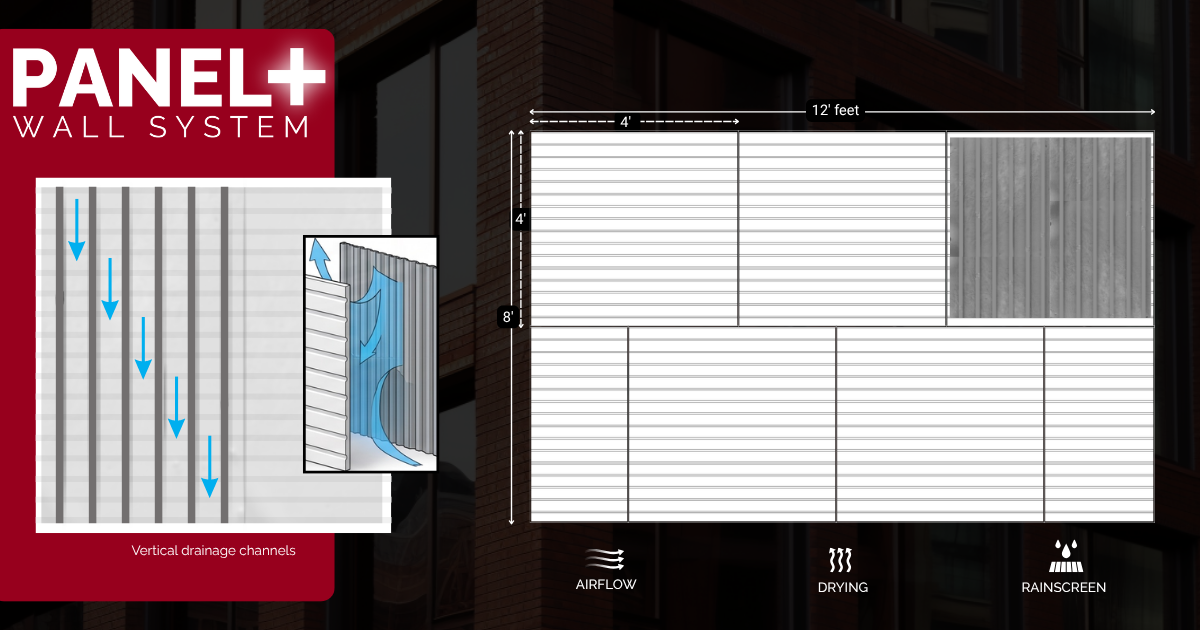
Moisture behind thin brick is not a defect by itself. It is part of how masonry veneer behaves.
Brick, stone, and mortar joints can absorb and pass incidental moisture during wind-driven rain. That is why high-performance wall assemblies should not rely on the veneer face to stop every drop of water. They need a backup plan.
The Panel+ Wall System from Old Mill Building Products is designed around that reality. With the Fluid-Applied Adhesive Method, Panel+ combines a continuous air and water barrier, vertically combed adhesive, EPS continuous insulation, and adhered thin brick, stone, or tile into one coordinated assembly.
The result is a water-managed wall system that directs incidental moisture down and out while supporting continuous insulation and authentic masonry veneer.
Key Takeaways
- Thin brick and stone veneer should be treated as reservoir claddings because they can absorb and release moisture.
- Panel+ does not depend on the veneer face alone to block water.
- The Fluid-Applied Adhesive Method uses Old Mill Air & Water Barrier over the sheathing as the primary drainage plane.
- Old Mill Adhesive is combed vertically with a ½-inch notch trowel to create drainage channels behind the EPS panels.
- Panel+ EPS foam panels provide continuous insulation, veneer alignment, and added moisture management.
- The system drains by gravity and supports drying through vertical pathways and vapor-permeable materials.
- Proper flashing, weeps, terminations, and open drainage paths are still required.
Why Moisture Management Matters Behind Thin Brick
Thin brick gives designers the look and durability of masonry without the weight and complexity of full-depth brick veneer. But it still behaves like masonry.
Brick and mortar are porous. They can take on water during rain events and release that moisture as conditions change. These types of claddings can absorb and store water, so they need drainage behind them. Without a drainage path, stored moisture can move into water-sensitive wall components.
That is the core issue Panel+ solves.
Instead of pretending water will never get past the veneer, Panel+ gives the wall a managed path for incidental water to drain and dry.
Is Panel+ a Rainscreen?
Panel+ is best described as a drainable insulated masonry veneer system.
It uses rainscreen principles, but it is not the same as a traditional ¾-inch or 1-inch open cavity rainscreen behind full-depth brick. In a conventional rainscreen, the cladding sits off the wall, creating a large open air cavity.
Panel+ works differently.
With the Fluid-Applied Adhesive Method, the drainage function comes from:
- A continuous fluid-applied air and water barrier over the sheathing
- Vertically combed adhesive ridges behind the EPS foam panels
- Built-in drainage and ventilation features in the Panel+ EPS profile
- Flashing and weep locations that allow water to exit the assembly
So the better way to explain it is this:
Panel+ uses a controlled drainage plane and vertical drainage channels to provide rainscreen-style moisture management in a thinner, integrated wall system.
That distinction matters. It keeps the claim accurate and avoids implying that Panel+ has a large open cavity behind the veneer.
How the Fluid-Applied Adhesive Method Works
The Fluid-Applied Adhesive Method starts at the sheathing.
First, the substrate gets treated with Old Mill Air & Water Barrier. This fluid-applied membrane forms a continuous air and water-resistive layer over approved substrates. It protects the wall from incidental water intrusion and helps reduce uncontrolled air leakage.
Once the barrier has cured, Old Mill Adhesive is applied over it with a ½-inch notch trowel. The adhesive is combed vertically before the EPS panels are installed. This step is important.
Those vertical adhesive ridges create drainage channels behind the EPS foam panels. If incidental water reaches this plane, gravity directs it downward instead of allowing it to sit trapped behind the insulation.
This approach is also used in drainable, adhesively attached continuous insulation systems. Vertical adhesive ribbons or channels create a path for water to move down the wall and exit at the base or other flashing locations.
The Role of the Air & Water Barrier
In Panel+, the Air & Water Barrier is the main backup layer.
The veneer is the first line of exposure, but not the only line of defense. If water gets past the thin brick, stone, tile, mortar joints, or transitions, the Air & Water Barrier protects the sheathing and directs water into the drainage path.
This is why field detailing matters.
The barrier must be continuous at:
- Sheathing joints
- Corners
- Fasteners
- Window and door openings
- Flashing transitions
- Penetrations
- Terminations
Panel+ does not work because of one material. It works because each layer does its job.
The veneer handles weather and impact. The EPS provides continuous insulation and veneer alignment. The adhesive secures the panels and creates vertical drainage. The Air & Water Barrier protects the sheathing. Flashing and weeps get the water out.
How the Vertical Adhesive Channels Drain Water
The vertical adhesive pattern is the key part of the Fluid-Applied Adhesive Method.
When adhesive is combed vertically, it creates raised ridges with open channels between them. After the EPS panel is pressed into place, those channels remain as downward pathways behind the panel.
That matters because water follows gravity. Horizontal adhesive ridges can block water and create dams. Vertical ridges help water move down.
This is the heart of the drainage design.
The system does not need a large open cavity to manage incidental moisture. It uses a thinner, controlled drainage pathway created by the adhesive pattern.
What the EPS Panel Adds
The EPS foam panel is not just insulation.
In Panel+, the EPS panel serves several functions:
- Continuous insulation
- Drainage support
- Veneer alignment
- A stable base for thin brick, stone, or tile
- A thermal break over framing
Old Mill EPS panels are closed-cell expanded polystyrene. That matters for water management. The EPS does not act like a sponge. It resists bulk water absorption and maintains dimensional stability when exposed to incidental moisture.
The panel profile also supports moisture movement. Built-in drainage and ventilation features help promote water egress and drying behind the cladding.
Drainage vs. Ventilation
Drainage and ventilation are related, but they are not the same thing.
Drainage removes liquid water.
Water moves down the wall by gravity through vertical pathways and exits at flashing or weep locations.
Ventilation helps remove water vapor.
Air movement and vapor-open materials help the assembly dry after bulk water has drained.
Panel+ supports this concept through its drainage channels, EPS panel profile, and vapor-permeable air and water barrier. The system helps water drain first, then gives residual moisture a path to dry.
Why Panel+ Is Different from a Face-Sealed System
A face-sealed wall depends on the exterior surface to stop water completely.
That is risky with masonry veneer because brick, stone, and mortar joints are not perfect water barriers. They move, crack, absorb moisture, and release moisture over time.
Panel+ takes a better approach.
It assumes incidental moisture may get behind the veneer and gives that moisture a controlled path out of the wall.
A durable wall needs:
- A cladding layer
- A drainage plane
- A drainage path
- Flashing and exit points
- Drying capacity
Panel+ integrates those principles into a system that also delivers continuous insulation and fast veneer installation.
How Water Moves Through the Panel+ Assembly
Here is the simple sequence:
- Rain hits the thin brick, stone, or tile veneer.
- Some moisture may pass through mortar joints, veneer pores, or transitions.
- Moisture reaches the water-managed layer of the assembly.
- The fluid-applied Air & Water Barrier protects the sheathing.
- Vertically combed adhesive channels allow water to drain downward behind the EPS panels.
- Built-in panel drainage features support water movement and drying.
- Flashing and weeps release water at the base of the wall, openings, or transitions.
- Residual moisture dries through ventilation paths and vapor-permeable materials.
The wall is not designed to trap water. It is designed to manage it.
Why This Helps Architects and Builders
Panel+ helps solve one of the biggest challenges in modern exterior walls: combining energy performance, moisture control, and masonry aesthetics without adding unnecessary complexity.
Traditional wall assemblies often require separate layers and trades:
- WRB or air barrier
- Continuous insulation
- Drainage mat
- Furring or cavity system
- Masonry layout system
- Veneer installation
Panel+ combines several of those functions into one coordinated system.
That matters on real jobsites. Fewer separate layers can mean fewer detailing mistakes, fewer trade conflicts, and faster installation.
Panel+ also supports current energy-code goals by placing continuous insulation outside the structure. Continuous insulation reduces thermal bridging through framing and helps improve whole-wall performance. The Panel+ system uses EPS insulation and can be specified in multiple thicknesses based on project needs.
The Importance of Flashing and Weeps
Drainage only works if water has a way out.
That means flashing and weeps are not optional details. They are part of the system.
Water must be directed out at:
- Base-of-wall conditions
- Window heads
- Door heads
- Shelf angles or horizontal breaks
- Roof and wall intersections
- Penetrations
- Other termination points
The drainage channels get water moving. Flashing and weeps finish the job.
A well-detailed Panel+ installation should always maintain open drainage paths at terminations. If those exits are blocked with sealant, mortar, adhesive, or poor detailing, water management gets compromised.
Panel+ Solves Moisture Management Without Overcomplicating the Wall
Thin brick and stone veneer assemblies need a plan for water. The goal is not to stop every drop at the face of the wall. The goal is to control incidental moisture, drain it, and allow the assembly to dry.
Panel+ solves this with a layered system:
- Fluid-applied Air & Water Barrier over the sheathing
- Vertically combed adhesive that creates drainage channels
- Closed-cell EPS continuous insulation
- Built-in panel drainage and ventilation features
- Proper flashing and weeps at exits
- Thin brick, stone, or tile cladding as the finished exterior
This gives architects and builders a practical way to get masonry aesthetics, continuous insulation, drainage, and installation speed in one coordinated wall system.
Panel+ does not just cover the wall. It helps the wall manage water.
FAQs
Does Panel+ create a rainscreen cavity?
Panel+ creates a drainable, water-managed assembly using vertical drainage channels and integrated panel features. It is not a traditional 1-inch open cavity rainscreen. It uses rainscreen principles in a thinner, integrated system.
How does the Fluid-Applied Adhesive Method create drainage?
Old Mill Adhesive is applied over the cured Air & Water Barrier with a ½-inch notch trowel and combed vertically. The vertical adhesive ridges create channels that allow incidental water to drain downward behind the EPS panels.
What protects the sheathing if water gets behind the veneer?
Old Mill Air & Water Barrier protects the approved substrate. It forms the primary water-managed layer behind the insulation and cladding.
Does EPS absorb water?
Panel+ EPS is closed-cell expanded polystyrene. It resists bulk water absorption and supports use in a water-managed wall assembly.
Are weeps still needed?
Yes. Any drainable wall system needs exit points. Flashing and weeps allow water collected by the drainage channels to leave the assembly.
Why does Panel+ work better than a face-sealed approach?
A face-sealed approach depends on the exterior surface to stop all water. Panel+ uses a water-managed strategy that accepts incidental moisture and gives it a path to drain and dry. That is a better fit for masonry veneer because brick, stone, and mortar can absorb and release moisture.